

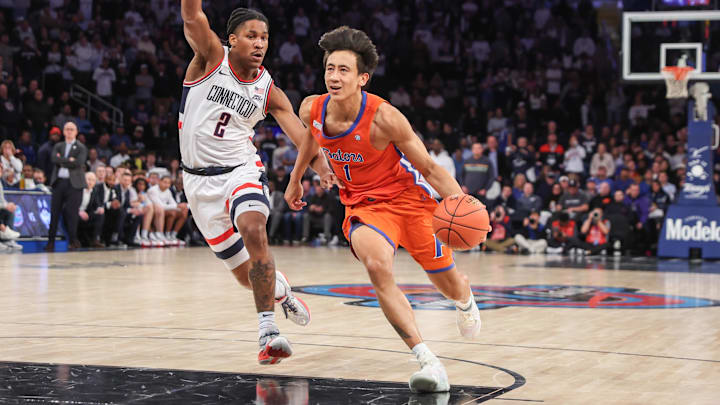
Todd Golden did a good job to keep his championship roster from last season intact this offseason, well, at least the front court. Florida brought back Thomas Haugh, Alex Condon, Rueben Chinyelu, and Micah Handlogten, but had to replace its entire backcourt after Walter Clayton Jr., Alijah Martin, and Will Richard left for the NBA, and Denzel Aberdeen transferred to Kentucky.
Through Florida’s 5-4 start to the 2025-26 season, that group of guards is proving to be somewhat irreplaceable, at least with the transfer portal swings that Golden took. Arkansas transfer Boogie Fland has been an inefficient scorer, but most of the Gators fans’ ire has been directed at Princeton transfer Xaivian Lee.
On Tuesday night, as Florida fell to UConn 77-73 at Madison Square Garden for the Jimmy V Classic, Lee had arguably his best performance as a Gator. The undersized point guard finished with 19 points, six rebounds, and five assists, the losing effort, but that doesn’t mean Florida’s backcourt problems are solved.
Xaivian Lee’s struggles mirror Dan Hurley’s cautionary tale
It was fitting that Lee’s best game of the season so far came against UConn, the 2024 national champions, because after winning the second of his back-to-back titles, Dan Hurley made the same mistake Golden did this offseason.
Just as Golden added Lee to fill Clayton’s shoes, ahead of the 2024-25 season, Hurley added Saint Mary’s transfer Aidan Mahaney to replace the NCAA Tournament’s Most Outstanding Player, Tristen Newton, at point guard. Only, his plan went bust. Mahaney, at 6-foot-3, 185 pounds, lacked the size and athleticism to make the jump from the WCC to the Big East. He got swallowed up by point of attack defenders and couldn’t finish at the rim, which led to turnovers and shooting woes. Sound familiar?
To add to the parallels, Hurley eventually had to bench Mahaney, forcing him to overextend the playmaking responsibilities of a score-first combo guard in Solo Ball. That’s the path Florida might be heading down with Fland.
The 6-foot-4, 180-pound Lee has had similar struggles to those Mahaney experienced when making the jump to Power Conference basketball. Lee has the quickness to create space and find driving lanes, but he can’t finish at the rim and is rushing his open looks from the outside, leading to a woeful 26.3 field goal percentage.
While he’s at a serious athletic deficit, he’s still playing like he’s one of the best athletes on the floor; challenging bigs at the rim and leaving his feet to make passes. The things he could get away with in the Ivy League are costing him huge against competition like UConn.
Xaivian Lee’s breakout performance wasn’t enough for Florida to topple UConn
Yet, Tuesday night was one of his better performances. Fland’s early foul trouble forced the ball into his hands, and he was able to make the most of a score-first mentality. He finished better at the rim, got to the foul line the most he has this season, and finished with zero turnovers. With a front-court heavy team, he had to be the primary ball-handler and initiator, and that decision-making load, unsurprisingly, wasn’t an issue for the former All-Ivy First-Teamer.
Still, even as the team’s leading scorer, you could argue his presence on the floor wasn’t a major plus for the Gators. He shot just 5-for-14 from the field and 1-for-7 from three, including an air ball on a deep step back after he called for a late-shot clock isolation against UConn forward Alex Karaban while trailing by six with 1:40 left.
That play highlights one of the major differences between this year’s team and last. Lee is primarily an on-ball creator, and Fland is a slasher, not a shooter. So, the combination of elite front-court passers and a back court with real shot gravity, which created all the great dribble hand-off action that Florida tortured defenses with a year ago, is gone.
On the other end of the floor, Lee isn’t the punching bag in the traditional sense. He’s too quick and gives too much effort as an on-ball defender for teams to simply target him in isolation. However, his slight frame and lack of strength cause him to struggle as a lock-and-trail defender, so UConn constantly ran him into off-ball screens, creating wide-open looks for Ball and Brayden Mullins, particularly when Chinyelu was in drop coverage.
Lee just isn’t an SEC athlete. The fact that he can have flashes of scoring volume against a team like UConn is a meaningful improvement, but if he’s going to be an additive force in a thin backcourt, he needs to learn to play more within himself.
He has to play almost like a Villanova guard under Jay Wright, relying heavily on jump stops and shot-fakes to keep defenders off balance while he remains in control. Even then, if his outside shot doesn’t improve, Florida will struggle to have the spacing it needs to play a starting lineup that includes 6-foot-10 Rueben Chinyelu, 6-foot-11 Alex Condon, and 6-foot-9 Thomas Haugh.
 Add us as a preferred source on Google