

It’s not easier to repeat in March Madness, but the Florida Gators have done it before. As Billy Donovan did in 2006-07, Todd Golden brought his loaded front court back after winning it all, but unlike Donovan, Golden had to replace his entire backcourt.
That’s proven to be quite the challenge, even as the Gators claimed a No. 1 seed, but after an SEC Tournament loss to Vanderbilt, they look to be much more vulnerable than a year ago. To repeat, Florida will have to navigate a loaded South Region and beat Houston in its own backyard.
Even reaching that Elite Eight matchup, though, won’t be a cake walk because there are plenty of elite players in the South Region who could spoil Florida’s repeat run. The run begins on Friday at 9:25 p.m. ET in Tampa.
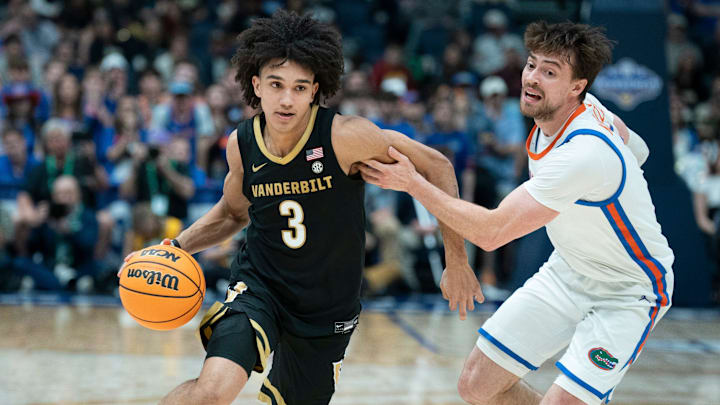
You’d have to imagine that Todd Golden does not want to see Vanderbilt again. If the seeds hold in the first round, though, all it would take is No. 5 Vanderbilt taking down No. 4 Nebraska in the Round of 32 to set up the rubber match between the Gators and the Commodores in the Sweet 16. If that happens, Vanderbilt point guard Tyler Tanner would be feeling good about the matchup.
At 19.1 points and 5.1 assists, Tanner has been the engine of the Vanderbilt offense along with his running-mate Duke Miles this season. There are plenty of games when Miles takes over, but against Florida, it’s been the Tanner show. The 6-foot point guard has stared down Golden’s supersized lineup and dropped 20 points in both games, going a combined 15-24 from the field and 3-5 from three.
Though he’s undersized, Tanner has been an elite finisher at the rim and scores 43.1 percent of his points in the paint. In the SEC Tournament, much of his 20 came on run outs in transition, but where he killed Florida was as a passer out of the pick-and-roll, constantly forcing the Gators into rotation and gobbling up space when Reuben Chinyelu or Alex Condon sat in drop coverage. Golden will need to make sure his team’s rotations are sharp if the Gators draw Vandy for a third time this year.
There are quite a few players in the country with a greater usage rate than Stirtz. The same was true when he played for Ben McCollum at Drake last year, and the Bulldogs pulled off a first-round upset of Missouri last season. However, this year and last, few players have done more with their playmaking workload than Stirtz, who was an All-American honorable mention both years.
Iowa runs a slow-paced heliocentric offense that relies on Stirtz to be an elite decision-maker, shot-maker, and distributor. Of players with at least a 25 percent usage rate, Stirtz is 15th in assist/turnover ratio, which is a key aspect of McCollum’s system, which values possession above all else. He’s also top 40 among that sample in true shooting percentage (per CBBanalytics.com), which, when you consider how often he’s asked to bail the Hawkeyes out of late shot clocks, is pretty remarkable.
Stirtz took over against Missouri last season. He controlled every aspect of the game, and while I don’t love a helio-centric offense in the NBA postseason, where a defense has a seven-game series to figure it out, it can be advantageous to have clearly defined roles in a single-elimination tournament.
Houston is not the same defensive team it was a year ago, when the Cougars fell one game short of their first national championship in program history. Still, they finished fifth in KenPom adjusted defensive rating, and what they’ve sacrificed on that end of the floor, they’ve made up for with a more dynamic offense, led by star freshman Kingston Flemings.
Flemings is a dynamic athlete with elite speed and quickness with the ball in his hands and serious vertical pop at the rim. The exact type of player that Xaivian Lee never saw in the Ivy League and struggled with through his first few months at Florida. Flemings shoots an inordinate amount of mid-range twos, but he hits them at an impressive enough clip to still have a 52.1% effective field goal percentage.
The five-star freshman isn’t all offense, either. Kelvin Sampson would have never recruited him if that were the case. He uses his athleticism and strength on the defensive end and could give Lee and Boogie Fland trouble at the point of attack.
Unlike Flemings, Keaton Wagler is not a dynamic athlete with crazy vertical pop and an NBA body. At times, the overlooked three-star freshman still looks like a baby deer at 6-foot-6, 180 pounds, especially when matched up with grown men like Michigan’s Yaxel Lendeborg. However, with Illinois’s five-out lineup, which oftentimes features two seven-footers, the Ivisic twins, it will be difficult for Florida to match him up with one of its bigger bodies like Thomas Haugh.
NBA evaluators may worry about his lack of dunks, especially at his size, but regardless of his vertical will be at the combine, he’s a capable finisher at the rim and has a decent enough floater game to finish when he can’t get all the way there. Where he thrives, though, is from beyond the arc, and if he gets hot, it could be lights out for any team in the tournament, not just Florida.
 Add us as a preferred source on Google