

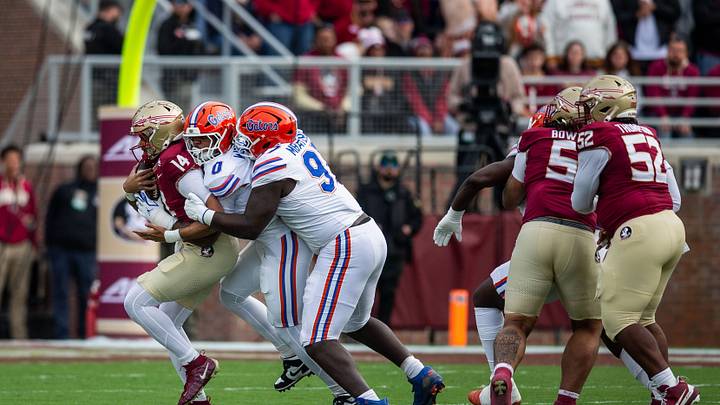
The biggest reason why FSU never really threatened Florida on Friday, even though Florida’s offense left a lot to be desired, was that Florida’s defense shut down almost everything FSU wanted to do. Aside from the 64-yard catch-and-run and the comical 4th-down TD by FSU’s backup QB, Florida kept a lid on everything.
It caps off a roller coaster year for the unit that started off as one of the worst in all of college football, but by the end of the year turned into a respectable unit that helped spark Florida’s end of the year surge.
Jon Sumrall likes the progress of Florida’s defense
Sumrall talked about Florida’s game plan and how they shut FSU down. We said before the game that Florida didn’t really need to fear FSU in the passing game, because FSU’s receivers seldom create separation and Ashton Daniels wasn’t going to hit them anyway, even if they did.
That largely played out as Florida’s secondary had FSU mostly on lock the whole night, and Daniels attempts to throw it downfield and hope someone was open were not a viable strategy. And because the front four for Florida was getting home with regularity, Florida didn’t need to blitz and the rate we saw them doing during the midway point of the season.
Sumrall also noted the turnaround that the unit as a whole has had and made sure to defend his defensive coordinator, Brad White:
“I think our defensive football team found themselves. Brad's done a great job. I know early in the year everybody was critical, probably of our defense. Brad's been a really good coordinator in this league for a long time. He knows what he's doing. We weren't where we needed to be at the beginning of the year. We're still not maybe where we need to be, but there's been signs of life. There's been growth.
We still have a lot of improvement that's needed there. But those guys have bowed their necks and responded to playing four-quarter football."
Count us among those who were highly critical of White and the job the defense was doing. Through the first six games of the season, Florida was giving up 29 points per game. Had they maintained that rate, that would have placed them 106th in the country. Over the last six games, Florida gave up just 20.8 points per game. A season-long rate of that would put Florida at 36th in the country.



And let’s be clear, even the last four games haven’t been perfect. This is still the same unit that game up a 20-play drive against Oklahoma and the same unit that couldn’t stop the run against a Vanderbilt team that hadn’t been able to run against anyone this year.
But the unit stiffened up in the second half against Texas, shut Kentucky down, and made FSU look lifeless. Even against Georgia, had Florida’s offense not morphed into a pumpkin, their fate might have been different.
Florida needs to take the correct lesson from this win
The gambit for Florida heading into the offseason is to not get fooled into thinking that Friday’s scheme against FSU is a recipe for long-term success in the SEC. Because the way Florida played on Friday is the preferred style for White:
Get home with just four rushers while playing a safe zone on the back end that requires a QB who knows what he is doing to exploit it.
Ashton Daniels didn’t know what he was doing, and so the scheme worked on Friday. But White’s tenure at Kentucky, as well as Florida’s efforts during the front half of the year when Florida played this same style, have proven this scheme doesn’t work against a QB who knows what he is doing.
Keep in mind that if White had been left to his own devices, Texas probably would have beaten Florida. Sumrall made the call to start blitzing like crazy. Before that game, a Brad White-led defense hadn’t blitzed more than 50% of the time since 2023.
Our hope is that we see things be a bit more dynamic in 2027 and not as static-based.
But the backend of 2026 showcased that Florida is able to at least get better and improve up early season problems.
 Add us as a preferred source on Google