

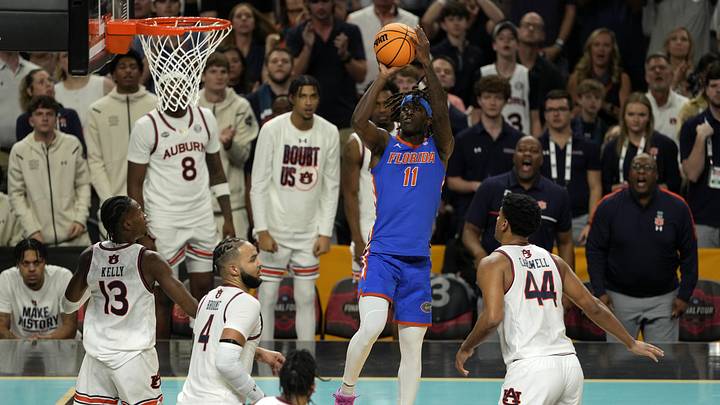
One sticking point for Florida this offseason has been whether Denzel Aberdeen will actually be cleared to play in the 2026/27 season. Aberdeen transferred back to Florida after one year at Kentucky, but on paper, is technically out of college eligibility to play another year.
The hope was that an NCAA ruling allowing players a 5th year, no matter what, would pave the way for Aberdeen, and while it appears the “5-for-5” model is going to be the way of the land, the fine print might not actually apply to Aberdeen.
Denzel Aberdeen still has to wait to play for Florida in 2026
The NCAA Division I Cabinet voted on Tuesday and is in support of a new model that would give players five full years that can be used however they choose. The key distinction compared to the rules now is that it would eliminate redshirts and allow players to play five full seasons if they want. The other key distinction is that an athlete’s clock starts at 19 at the latest, meaning a 21-year-old can’t start as a freshman.
But in the fine print, ESPN noted:
“Athletes who just completed their fourth season of eligibility without a redshirt would not be granted an additional year. Schools will have flexibility in determining whether to use previous eligibility rules or the new age-based model for athletes with eligibility remaining after the 2025-26 academic year.”
This is where the Aberdeen conundrum comes into play.
By rule, Aberdeen has exhausted four seasons of eligibility, and, based on the way this new NCAA proposal is written, he will not be eligible for the 2026/27 season. What is bound to be contested is the fact that one of those years was his 2022/23 campaign with Florida, when he played a grand total of 40 minutes for the whole season, 17 of which weren’t until his final two appearances against LSU and UCF.
Basketball rules state that if you appear for one minute during the entire season, then that counts as a year of eligibility.
Rules for thee and for me
Scott Stricklin stated earlier this month that he would be in support of any pathway that Aberdeen wanted to pursue to become eligible if the NCAA didn’t rule in his favor. And in a landscape where it feels like everyone else can just run to the courts to get their way, why shouldn’t Florida get its own slice of cake?
Plus, in football, guys have a pathway to appear as a true freshman and still keep redshirt status, and Aberdeen saw no more action than any of those guys.
But, and this is the but that Florida is going to have to find an argument against, Aberdeen and Florida knew full well in 2022 when he stepped on the court against Stony Brook for three minutes that it was going to count, at the time, as a year of eligibility.
Is it archaic?
100%.
Was Aberdeen and Todd Golden a wizard who could see into the future that this “5-for-5” rule would be a thing four years later?
We’ll just say less than 100%.
So get ready for some court challenges and who knows what else to see if one of the key cogs to Florida’s offense for 2026/27 can actually get onto the court, or whether Golden is going to be forced to figure out a Plan B.
 Add us as a preferred source on Google